The harvest desk
Open a drawer
The name, the clockwork model, a careful line about the Great Exhibition, a darker early history, a church weekend in Rutland, sacks in a Finnish stubble, and what English farms actually spent on machinery.
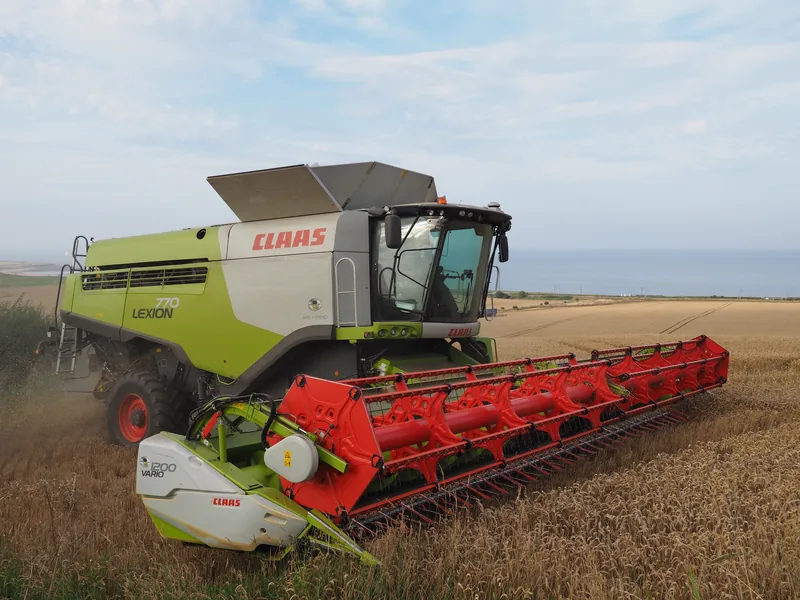
Open a drawer to look closer at the machine that takes its name from two jobs at once: a clockwork thresher that became the museum’s second object, a 1945 tanker combine whose weekend’s work helped a church, sacks left in a Finnish stubble, and a modern harvest that still has a county missing from its caption.
It combines two jobs, and that is the name
The Museum of English Rural Life puts the name in one clean sentence. Combines “are so-called because they combine the cutting of a crop—reaping—and the separation of grains from stalks—threshing.” Before one machine did both, a reaper cut, a reaper-binder tied, and a thresher separated the grain. The combine, as the Museum’s technology notes put it, “does it all.” Modern ones are “controlled by computers.” [source] [source]
A clockwork thresher, object 51/2
The MERL’s second formally recorded object, numbered 51/2 in January 1951, is a small clockwork model of a threshing machine, made by Barrett, Exall & Andrewes around 1847 in Katesgrove Lane, Reading. It is a demonstration model of a four-horse-powered thresher. Transferred from Reading Museum to the University of Reading’s Faculty of Agriculture around 1946, it later joined the new museum and still goes out on the handling trolley. Dr Ollie Douglas, Curator of MERL Collections, tells its story as Object 1 of 51 Voices. [source] [source]
Similar machinery, perhaps this very model
The firm exhibited similar machinery at the Great Exhibition in 1851 — “perhaps including this very model,” Douglas writes. The Museum’s object page puts the same moment slightly differently: Barrett, Exall & Andrewes exhibited “this same type of thresher” at the Great Exhibition, a century before the model entered The MERL. The visible story here follows that careful wording: the type was there; the model itself is a “perhaps.” [source] [source]
Machines, protest, and a life in Tasmania
Douglas places the model in a harder history too. Of rioters in 1830s Berkshire tried for protesting against such technologies, most were imprisoned, a few were transported to Australian prison colonies, and “one was even executed by hanging.” At least one, Thomas Mackrell, “would later turn his hand to farming in Tasmania.” The Museum links this, carefully, to settler-colonial land appropriation. The wording on this site stays with that official account. [source]
A 1945 tanker combine, working for a church
At Little Casterton in Rutland, on 19 September 2009, Michael Trolove photographed a 1945 Massey Harris 21A tanker combine harvesting wheat at a working weekend. The Commons file describes a gathering of rare and unusual farm machines operating for public viewing, with proceeds going towards the maintenance of Little Casterton church. A tanker combine was the later answer to the bagger: grain went into a tank, not into sacks left in the stubble.
Filled sacks, lying in a Finnish field
On 31 August 1963, Erkki Voutilainen photographed a combine at work in Finland. In the foreground, filled sacks already lie in the stubble. It is a picture of a machine that has cut and threshed, and of a job that still needed hands at the end of the spout. The photograph belongs to the JOKA Press Photo Archive of the Finnish Heritage Agency.
English farms, and a £2.3 billion machinery bill
Defra’s Farm Business Survey, covering England in the March–February year 2023/24, finds that farms spent £2.3 billion on machinery, 3% lower in real terms than in 2014/15. The mean net expenditure was £35.5 thousand per farm, and 74% of farms purchased machinery. The highest average (median) spend was on tractors, at £62.8 thousand. The notice does not publish a separate official figure for combine harvesters, so this site does not invent one. [source]
Keep exploring
Enjoyed the harvest?
No pop-ups. No intrusive advertising. Just interesting stuff. A little support helps the next farmyard site get built.