Discoveries
Things you might not know about the harvest machine
A name that is a job description, a model that may have reached Hyde Park, a Festival reviewer who could not find a combine on the 1951 carousel, sacks in a stubble, and a county that a caption still will not name.
The name is the job
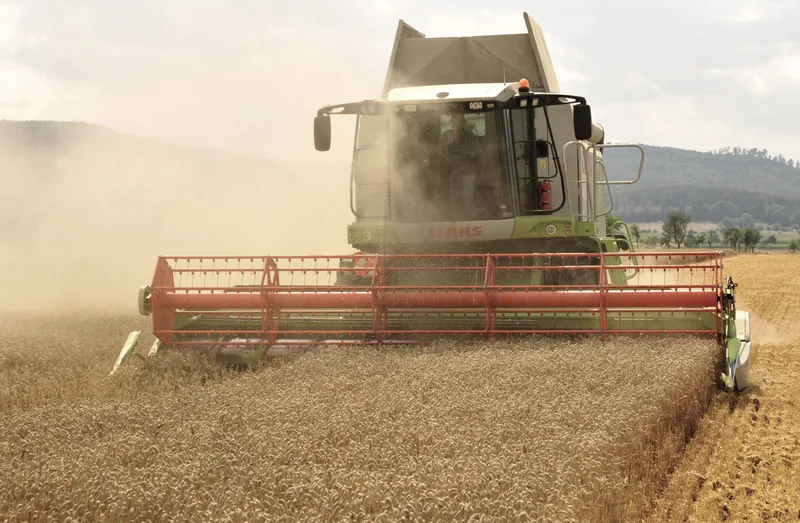
Combines “are so-called because they combine the cutting of a crop—reaping—and the separation of grains from stalks—threshing.” It is one of the more literal machine-names in the farmyard. [source]
The museum’s second object is a clockwork thresher
Object 51/2, formally recorded in January 1951, is a Barrett, Exall & Andrewes model of about 1847, made in Katesgrove Lane, Reading. It later went out on the handling trolley. [source] [source]
It spent five years teaching agriculture students first
Around 1946 the model was transferred from Reading Museum to the University’s Faculty of Agriculture, and was “almost certainly placed into immediate service” before it joined the new museum. [source]
The Great Exhibition is a “perhaps”
The firm “exhibited similar machinery (perhaps including this very model)” in 1851. The object page says they showed “this same type of thresher.” Type is certain; this exact model is not. [source] [source]
A darker early history travelled as far as Tasmania
Of Berkshire rioters tried in the 1830s for protesting against such technologies, most were imprisoned, a few were transported, and “one was even executed by hanging.” Thomas Mackrell “would later turn his hand to farming in Tasmania.” [source]
Filled sacks once lay in the stubble
Erkki Voutilainen’s photograph, taken in Finland on 31 August 1963, shows a combine at work and filled sacks already on the ground. Cutting and threshing had met; bagging had not yet left the field.
A 1945 tanker combine still worked for a church
On 19 September 2009, at Little Casterton in Rutland, a Massey Harris 21A tanker combine harvested wheat at a working weekend. The proceeds of the entry fee went towards the maintenance of Little Casterton church.
One modern combine is only “somewhere in England”
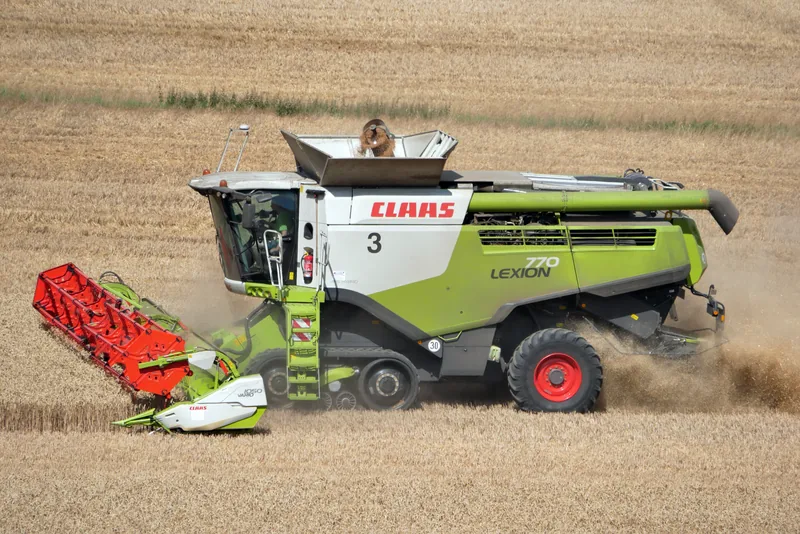
Mick photographed a Claas Tucano 430 with a 6 m Claas V 600 header on 11 August 2010. The file says “somewhere in England, UK,” and does not name a county. The machine is particular; the map reference is not.
English farms spent £2.3 billion on machinery in 2023/24
That official Farm Business Survey total is 3% lower in real terms than in 2014/15. Seventy-four per cent of farms purchased machinery. The notice does not publish a separate combine figure. [source]
The highest average spend was not on combines
The highest average (median) spend in that survey year was on tractors, at £62.8 thousand. New tractors averaged £92 thousand, used ones £30.6 thousand. [source]
A rusty Claas still stands in a French museum
Cjp24 photographed a Claas combine at the Musée de la machine agricole, Saint-Loup, in the Nièvre, on 20 September 2020. Not every combine’s last field is a field.
The modern ones are “controlled by computers”
The MERL’s technology notes draw a short line from reaper to reaper-binder to thresher to the combine “which does it all,” and then to machines “controlled by computers.” [source]
A Festival reviewer looked for a combine in 1951, and did not find one
Barry Evans and William Kempster’s Country Year carousel showed mechanised haymaking and harvest, but The Engineer remarked that “there is, however, no reference to the combine-harvester, which is by now extensively employed in this country.” The machine was already common enough to be missed. [source]
The painted harvest still used a thresher and a steam engine
The preparatory harvesting sketch at The MERL, object 2019/5, shows “tractors, reapers, a threshing machine, and a steam engine,” “instead of the modern combine harvester.” Cutting and threshing are both there — still as separate jobs. [source]
The writer Laurie Lee convened the farming theme
Evans later recalled that, for the Farming pavilion, “there was a theme convener called Laurie Lee, the writer. He was a few years older than me, probably in his thirties, a delightful person to work with.” That is Evans’s memory, written down in Dr Naomi Lebens’s essay. [source]
Keep exploring
Enjoyed the harvest?
No pop-ups. No intrusive advertising. Just interesting stuff. A little support helps the next farmyard site get built.