For families
A harvest machine you can explain in two jobs
A combine has a long, serious history, but the heart of it can be said to a curious child in a single sentence: it cuts the crop and it knocks the grain out, and that is why it has its name.
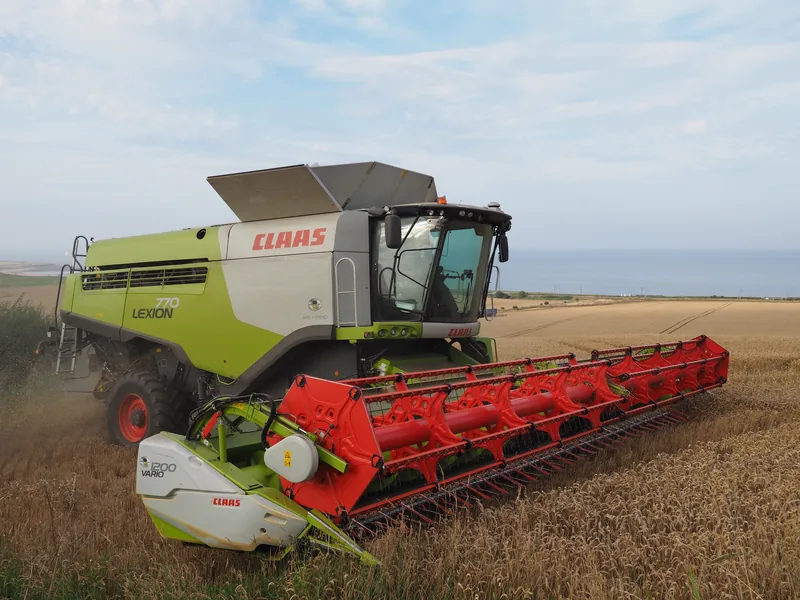
If you have ever picked seed from a dry stem, you have already done a tiny version of threshing. If you have ever snipped a stem, you have already done a tiny version of reaping. A combine is the farm’s way of doing both before it goes home.
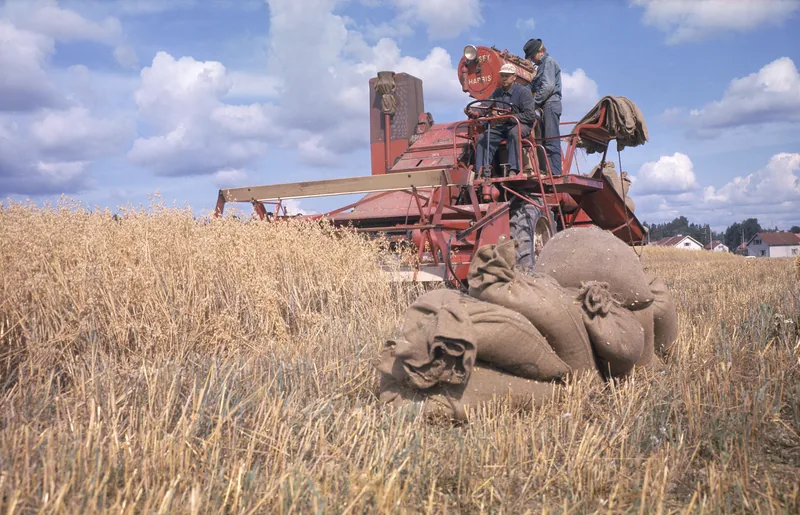
Look closely at the Finnish photograph from 1963. The machine is already at work, and sacks are already sitting in the stubble. For a long time, people still had to lift the grain. Later machines, called tankers, kept the grain on board — like a bucket that travels with you, instead of a row of bags on the ground.
In Reading there is a clockwork model of an older threshing machine, made around 1847, that visitors can still see and sometimes handle. It is not a toy, though it looks a little like one. It was made to show how a real machine worked. [source]
At the Festival of Britain, a few years after that model arrived at the University, artists painted the harvest of 1951 on a merry-go-round. They showed tractors and a threshing machine and a steam engine — but, a reviewer noticed, not a combine, even though combines were already widely used. Sometimes the newest machine is the one a picture leaves out. [source]
This site is for reading together, not for climbing on machines or walking in a crop without the farmer’s say-so. Harvest fields are workplaces.
Keep exploring
Enjoyed the harvest?
No pop-ups. No intrusive advertising. Just interesting stuff. A little support helps the next farmyard site get built.