Myths versus facts
What people assume, and what the record says
A few of the tidy stories about combines come apart as soon as you read the museum label, or the caption on a photograph.
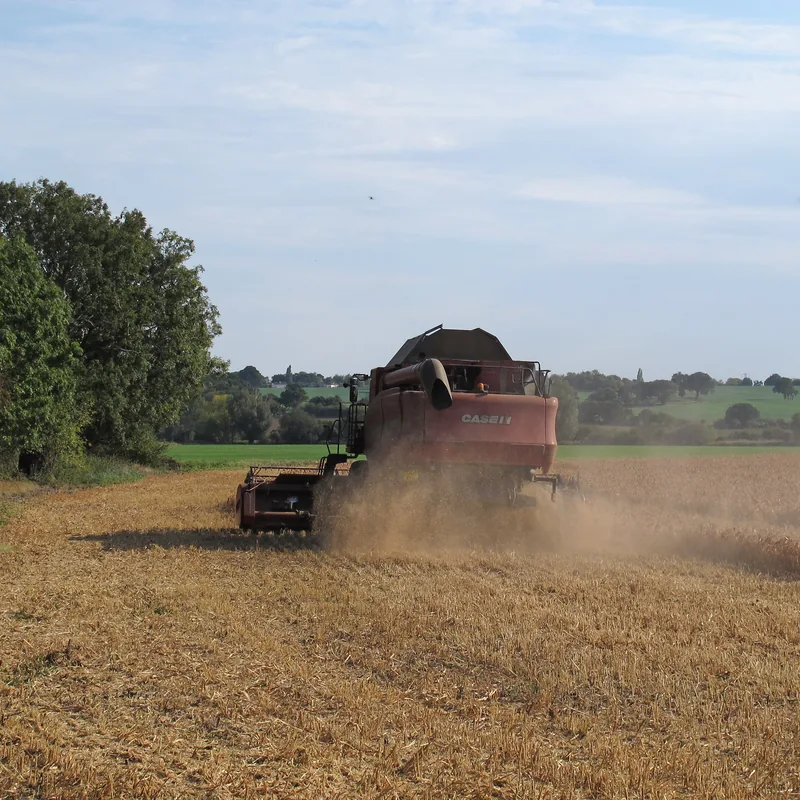
Myth
A combine is called a combine because several firms combined to build it.
Fact
The MERL’s wording is simpler and better: combines “are so-called because they combine the cutting of a crop—reaping—and the separation of grains from stalks—threshing.” [source]
Myth
The MERL’s clockwork thresher definitely stood at the Great Exhibition.
Fact
Douglas writes that the firm “exhibited similar machinery (perhaps including this very model).” The object page says they showed “this same type of thresher.” This site keeps the perhaps. [source] [source]
Myth
Object 51/2 was the first thing the museum catalogued.
Fact
It was the second artefact formally recorded in January 1951. The ‘51’ is the year; the ‘2’ is the place in the queue. [source]
Myth
Once a combine arrived, nobody had to handle the grain in the field.
Fact
Bagger-era machines still left filled sacks in the stubble, as Erkki Voutilainen’s 1963 Finnish photograph shows. Tanker combines, such as the 1945 Massey Harris 21A at Little Casterton, kept the grain on board.
Myth
The Massey Harris at Little Casterton was a typical commercial harvest in 2009.
Fact
It was a working weekend of rare and unusual farm machines, photographed for public viewing, with proceeds going towards the maintenance of Little Casterton church.
Myth
Defra publishes a neat official total for what English farms spend on combines.
Fact
The 2023/24 Farm Business Survey gives a total machinery spend of £2.3 billion, and a highest average (median) spend on tractors of £62.8 thousand. It does not give a separate official combine figure. [source]
Myth
The Claas Tucano 430 photograph can be located to a named English county.
Fact
Mick’s file places it “on a field somewhere in England, UK,” and does not name a county or a farm.
Myth
Threshing machines were welcomed everywhere as soon as they appeared.
Fact
Douglas records that machines of this kind were a focus of early-nineteenth-century rural protest. Of rioters in 1830s Berkshire tried for protesting against such technologies, most were imprisoned, a few were transported, and “one was even executed by hanging.” [source]
Myth
A reaper is just another word for a combine.
Fact
The MERL’s technology notes set out a sequence: reaper, then reaper-binder, then thresher, then the combine “which does it all.” [source]
Myth
Every combine photograph on this site is from a British harvest.
Fact
Voutilainen’s 1963 picture is from Finland. The Lexion photographs are from Germany. The rusty Claas stands in a museum in Saint-Loup, in the Nièvre, France.
Myth
The Reading model is too fragile to be touched.
Fact
Douglas writes that it “has been on the Museum’s handling trolley in our galleries and has played a regular part in our public programmes.” [source]
Myth
Modern combines are still purely mechanical, like the 1847 model.
Fact
The MERL notes say modern combines are “controlled by computers.” [source]
Keep exploring
Enjoyed the harvest?
No pop-ups. No intrusive advertising. Just interesting stuff. A little support helps the next farmyard site get built.