History
From two jobs in a field to one machine that does it all
Harvest once asked a farm for a run of separate skills. Someone cut the crop. Someone bound it. Someone later beat the grain from the straw. The combine is the machine that folded those jobs together, and then went on folding: first the sacks, then the tank, then the computers.
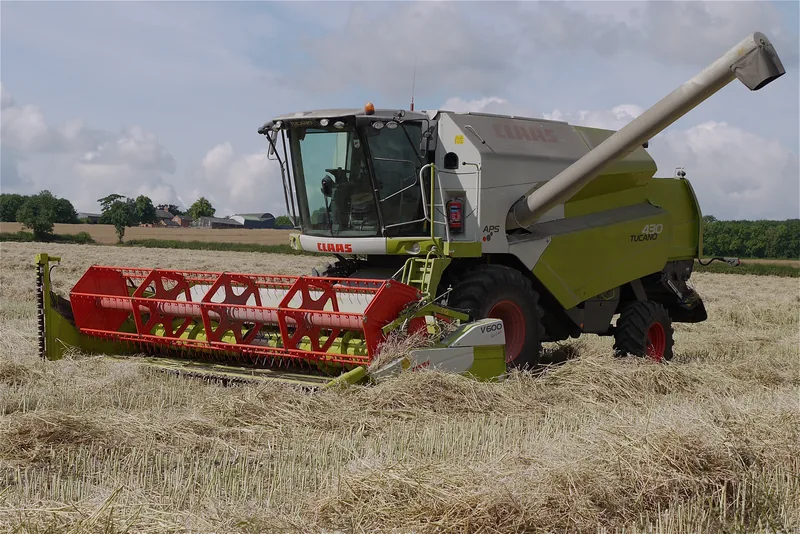
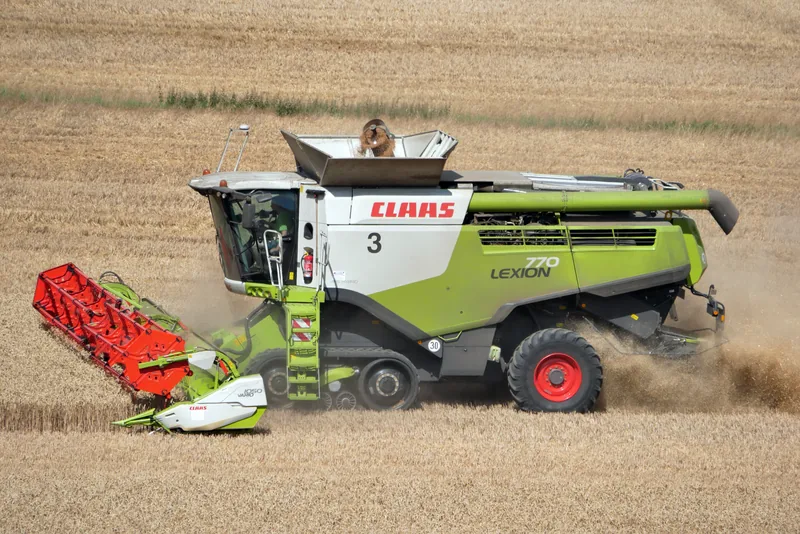
The MERL’s technology notes set the sequence out simply: the reaper, then the reaper-binder, then the thresher, then the combine “which does it all.” Modern combines, the same notes say, are “controlled by computers.” A Claas Tucano 430, photographed by Mick on 11 August 2010 “on a field somewhere in England,” is one later face of that line. The file does not name a county. The machine still has a 6 m header, and still has a name that tells you what it does. [source]
The older half of the story sits in a museum drawer in Reading. Barrett, Exall & Andrewes made a clockwork demonstration model of a four-horse-powered threshing machine around 1847, at their ironworks in Katesgrove Lane. Horse-powered machines of that kind, Douglas writes, made threshing “not only easier, but cheaper, faster, and more efficient.” The adaptation had begun in the late eighteenth century and “began to take more substantial hold during the first half of the nineteenth century.” [source]
That efficiency had a human cost, which the same essay does not tidy away. Of rioters in 1830s Berkshire tried for protesting against such technologies, most were imprisoned, a few were transported to Australian prison colonies, and “one was even executed by hanging.” At least one of them, Thomas Mackrell, “would later turn his hand to farming in Tasmania.” The Museum links this carefully to settler-colonial land appropriation. [source]
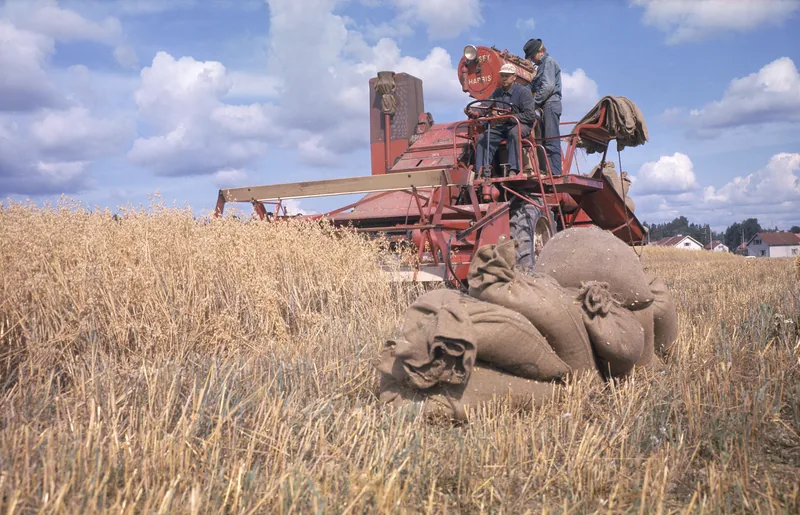
When cutting and threshing finally shared a chassis, the grain still often left the machine in a sack. Voutilainen’s 1963 Finnish photograph shows that bagger-era harvest in one frame: a combine in ripe crop, and filled sacks already lying in the stubble. The later tanker combine — the Massey Harris 21A at Little Casterton is one — kept the grain on board until a trailer came alongside.
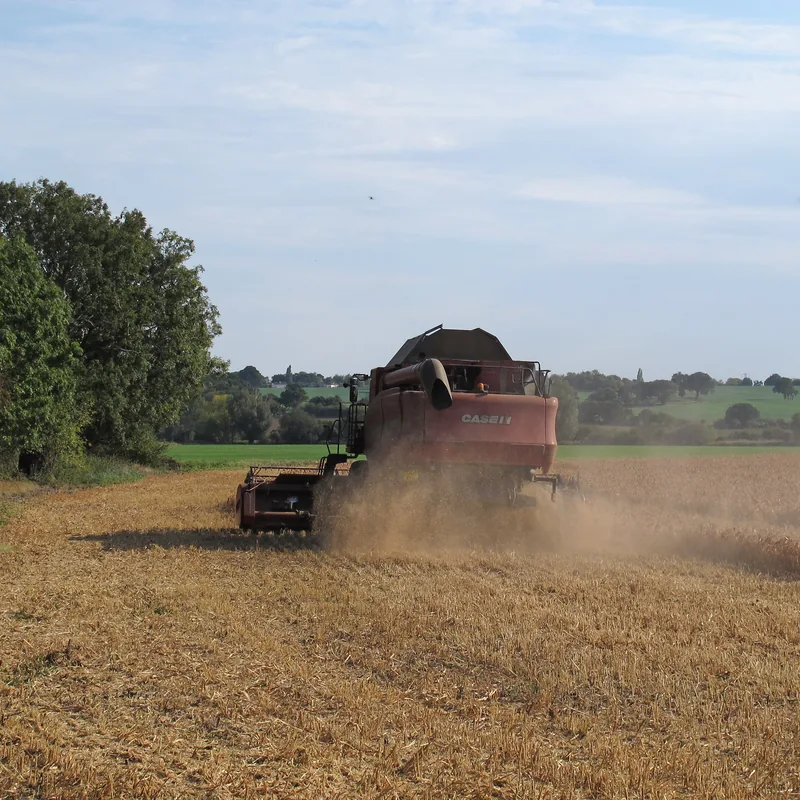
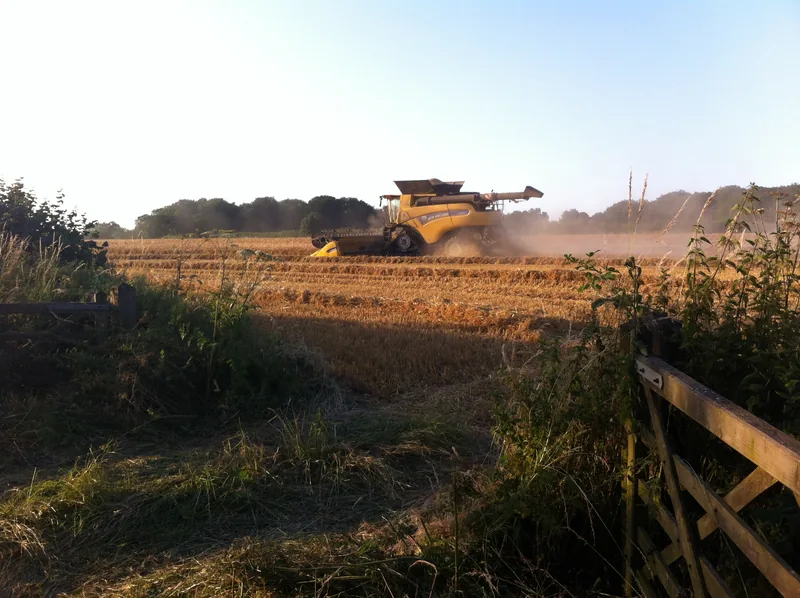
Looked at from a lane, the later machines can seem almost like buildings on wheels: a wide header, a high tank, a long walk up to a glass cab. At Astley in July, or at Stanford Rivers in September, or at Birnieknowes in late August, the work is still the same two jobs the Museum named, only now they are done before the machine turns at the headland. The driver is not a reaping gang, and not a threshing gang, and not a row of people tying sacks. One person, and a lot of engineering, have taken the place of a crowd.
The machines grew, and so did the bill for everything that moves on a farm. Defra’s Farm Business Survey for England, in the March–February year 2023/24, records £2.3 billion spent on machinery, 3% lower in real terms than in 2014/15. Seventy-four per cent of farms purchased machinery. The highest average (median) spend was on tractors, at £62.8 thousand. The notice does not give a separate official total for combines, and this site does not invent one. [source]
Even a Festival of Britain reviewer could already see how common the machine had become. In 1951, Barry Evans and William Kempster painted twelve panels of the country year for a merry-go-round in the Country Pavilion. The haymaking and harvest scenes, a writer in The Engineer said, “all show the impact of mechanisation on agriculture. There is, however, no reference to the combine-harvester, which is by now extensively employed in this country.” The preparatory harvesting sketch that survives at The MERL, object 2019/5, shows what was painted instead: “tractors, reapers, a threshing machine, and a steam engine.” Cutting and threshing are both in the picture — still as separate machines. The combine, already at work in the real fields, had not yet been invited onto the carousel. [source] [source]
Barry Evans later remembered that the Farming pavilion had “a theme convener called Laurie Lee, the writer.” The full-size murals later went to the new Museum of English Rural Life, were shown at the Royal Agricultural Show at Newton Abbot in 1952, and were then lost. Five designs survive, including that harvest sketch. The sister site on haymaking tells the June half of the same story. [source]
Keep exploring
Enjoyed the harvest?
No pop-ups. No intrusive advertising. Just interesting stuff. A little support helps the next farmyard site get built.