Home · Facts
Facts, kept in their official boxes
- MERL’s 51 Voices wording is that modern combine harvesters “are so-called because they combine the cutting of a crop—reaping—and the separation of grains from stalks—threshing.” [source]
- MERL’s Farming: The First 12,000 Years says: “Today, harvesting, threshing, and winnowing can all be carried out by a single machine – the combine harvester.” A later sentence on the same page speaks of “combining threshing, winnowing, and sieving all in one.” Those official lists are kept unmerged. [source]
- A MERL learning resource describes the reaper (which cuts the crop), the reaper-binder (which cuts and binds), the thresher (which separates the grain from its husks and stalks) and then “the combine harvester which does it all.” [source]
- Defra’s Farm Business Survey statistics for England record investment, not a published count of combine harvesters. The official dataset category is “Harvesting equipment.” [source] [source]
- In 2023/24, the official dataset says 13% of farm businesses in England bought harvesting equipment, with a mean spend of £4,000 per farm and a median spend of £11,500 among farms that bought some. [source]
- The official total spent by farms in England on all machinery was £2.3 billion in 2023/24. About 74% of farms purchased machinery. The highest official average (median) spend was on tractors, at £62.8 thousand. [source]
- In 2023/24, the notice says, the sample of 1,373 farms represented approximately 51,300 farm businesses in England. Farm classification for these 2023/24 results uses 2017 standard output coefficients. [source]
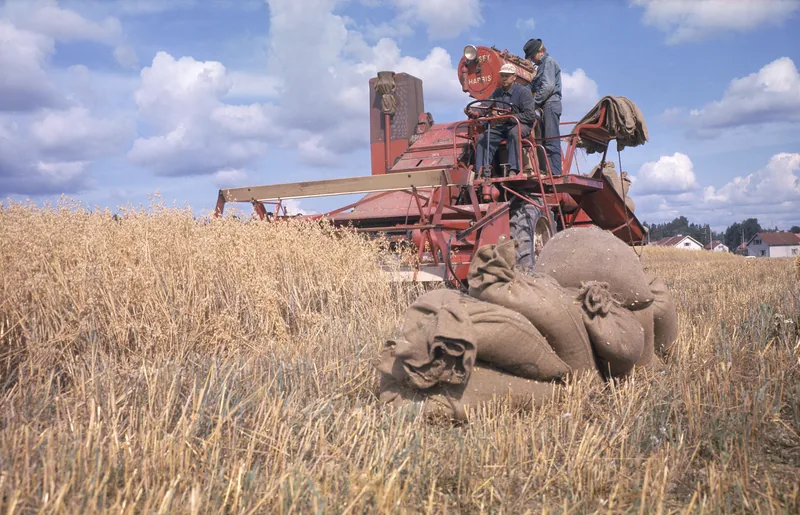
The photograph above is a Finnish Heritage Agency picture of a combine at work in Finland on 31 August 1963. It is included as a clear, freely licensed historical photograph, and is not an English Farm Business Survey record.
Enjoyed the harvest?
No pop-ups. No intrusive advertising. Just interesting stuff. A little support helps the next farmyard site get built.