farmyard.im
It is called a combine because it does two jobs at once
The Museum of English Rural Life puts the name in one clean sentence. Combines “are so-called because they combine the cutting of a crop—reaping—and the separation of grains from stalks—threshing.” For most of farming history those were two different days, two different gangs, and two different machines.
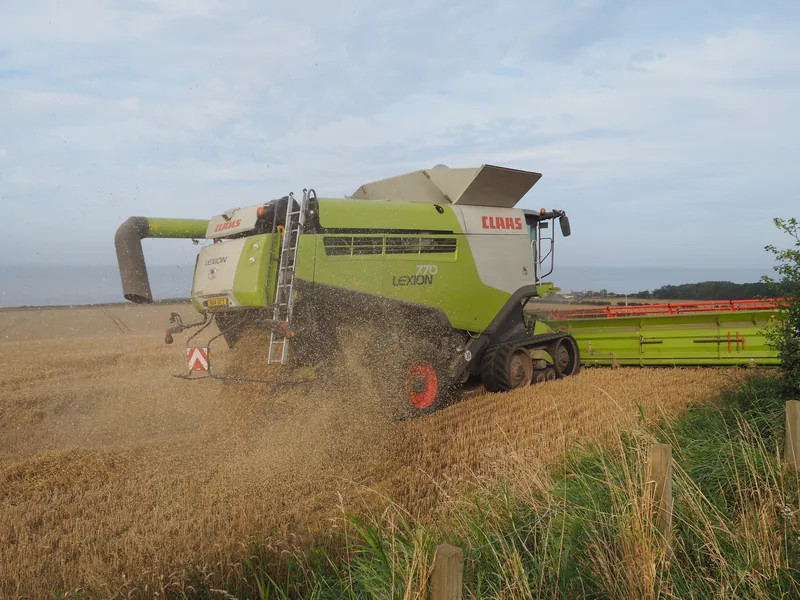
At Birnieknowes, in the civil parish of Oldhamstocks, Jennifer Petrie photographed a Claas combine taking wheat in a single pass on 24 August 2019. The header cuts; the drum threshes; the grain goes up into a tank; the straw is dropped behind. That everyday mid-harvest picture is the end of a long argument about work, cost, and who stayed in the field.
A much older machine still tells the first half of the story. In January 1951, the newly formed Museum of English Rural Life formally recorded, as its second object, a small clockwork model of a threshing machine, made around 1847 by Barrett, Exall & Andrewes in Katesgrove Lane, Reading. It still goes out on the Museum’s handling trolley. Dr Ollie Douglas tells its story as Object 1 of 51 Voices. [source] [source]
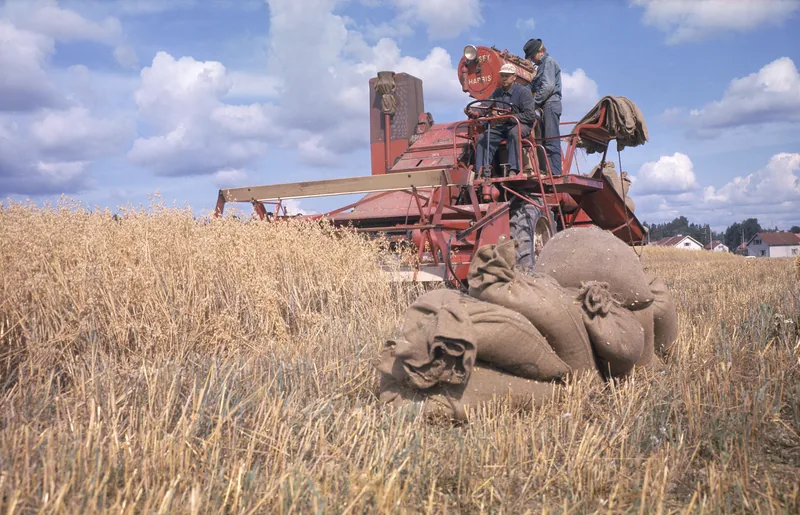
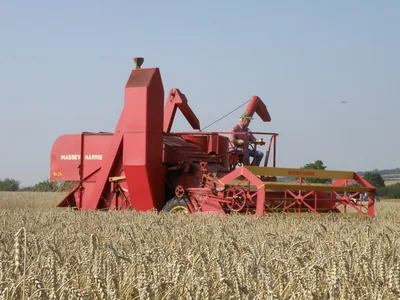
Even after cutting and threshing lived in one machine, the grain did not always go quietly into a tank. In Erkki Voutilainen’s photograph from Finland, taken on 31 August 1963, filled sacks already lie in the stubble. At Little Casterton, in Rutland, a 1945 Massey Harris 21A tanker combine was still at work in 2009, on a weekend whose proceeds went towards the maintenance of the village church.
By 1951 the machine was already common enough to be missed. A reviewer in The Engineer, looking at the Festival of Britain’s Country Year panels, wrote that they showed the impact of mechanisation on agriculture, but that “there is, however, no reference to the combine-harvester, which is by now extensively employed in this country.” The painted harvest still used a thresher and a steam engine. [source]
Where to start
- The clockwork thresher Object 51/2, a Reading ironworks, and a model that may — only may — have reached the Great Exhibition.
- Discoveries Sacks in the stubble, a church weekend, a county missing from a caption, and a £2.3 billion machinery bill.
- The harvest desk The name, the model, the protests, the tanker, and the official spend, drawer by drawer.
- Machines in the field From a 1945 Massey Harris to a Claas still standing in a French museum.
- Facts A long file of people, firms, photographs and official figures.
- Myths versus facts What people assume about combines, and what the record actually says.
- A quiz and a timeline Test yourself on the name, the model and a few surprises.
- Free fact sheets Three typographic PDFs, in A4 and Letter, with no photographs inside.
Keep exploring
Enjoyed the harvest?
No pop-ups. No intrusive advertising. Just interesting stuff. A little support helps the next farmyard site get built.